I would dearly love to have met Bobby Darin. To be able to pat him on the back and to shake hands with him. I'd feel it my need to offer reassurance that "Splish Splash" would still retain great entertainment value long after it became his breakthrough hit. I'd also have to confirm that "Queen of the Hop" remained one of the finest 'shuffles' of its kind whilst I'd certainly endorse the enduring qualities of "Dream Lover." Finally, I'd make sure I singled out "Bullmoose" as a major contender for just about the most powerful flipside of its day. Only then would I be a happy camper.FIERCE DETERMINATION
The opportunity to expound my enthusiasm to Bobby about his rock n roll involvement, unfortunately never came. However, those who knew him, worked with him and respected him, all seem to have shared a glowing fondness for this talents.
Connie Francis for instance in her book Who's Sorry Now, states that "he was dynamic, versatile, chock full of energy, with a fierce determination and an intensity I had never seen before." The week that Connie recorded Bobby Darin's "My First Real Love" in 1956, the song's writer was getting his first real deal with Decca Records. The label booked him into The Pythian Temple, the studio in Manhattan where all the Haley hits were coming from, and he also won an appearance on the Dorsey Brothers' CBS TV show - the week after Elvis made his national television debut.
Across the next twelve months Decca put out no less than four Bobby Darin singles without ever getting a shot at the charts. Nevertheless, the same degree of assiduity that drove the young singer was shared with his co-writer and publisher Donnie Kirschner, who soon sought out a new and more sympathetic home for his artist. Taking his lead from what Lester Sill had done with The Coasters, Kirschner managed to persuade Ahmet Ertegun that Bobby Darin could be Atco's next rock n roll star. He was dully signed and the production chores were taken care of by Ahmet's partner Herb Abramson.
In an ideal world Bobby Darin should have purloined a hit record straightaway but it wasn't to be. The three Abramson-produced singles that Atco went with throughout the spring, summer and fall of 1957 all failed to capture the distinction and persona that Darin obviously had oodles of. Decidedly worried that the label would sooner or later be dispensing with his services, Bobby was talked into returning to Decca early in January 1958, where he recorded four new sides under the supervision of Murray Kaufman. After the session, Kaufman (who was then just beginning his career as a DJ - Murray the 'K') invited Bobby over to his home where a conversation with his mother led to the hasty construction, around the family piano, of "Splish Splash." Whilst everyone else knew of its hit potential, Herb Abramson back at Atco was by no means convinced, so he didn't include it on the next date he produced on Darin at the end of the month.
Fortunately, Ahmet Ertegun thought otherwise and after hearing some further promising material he agreed to allocate a split session with singer Morgana King. This time though, he would be producing the proceedings himself. So it was that on April 10, 1958 the seeds were sown for Walden Robert Cassotto to record the signature rock n roll songs that would catapult him into teen idol status by the summer of that year.
"IT'S STARTING TO COOK!"
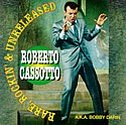
The fruits of those first two beat-generated years have now been laid bare courtesy of a 30-track CD entitled Rare, Rockin' and Unreleased: Roberto Cassotto - a.k.a. Bobby Darin - (Ring of Stars R-O-S 1001).
With such a long and messy appellation it isn't surprising that there's a skull and crossbones flying from the flagpole on this release, which in many ways is a shame. Surely an artist of Darin's stature deserves to have the full monty done on his recorded works sooner or later. Bearing in mind that it is almost twently-four years since he died and apart from a Rhino set and a rather token Atlantic compilation, precious little concise documentation has so far been undertaken. So perhaps this 'Italian' release should be given more than just a cautious welcome.
It is anyone's guess where these tapes have come from but on this occasion let's not bother calling in the CIA because this stuff just has to be heard. Rightaway it is worth remembering that engineer Tom Dowd had only just installed the new all-singin', all-dancin' stereo-capable 8-track tape machine the month before the "Splish Splash" session. To say that Bobby Darin was excited over the prospects would've been an understatement.
However, the ebullient mood must have been tempered by the news that morning of the death of Atlantic star Chuck Willis - who ironically had been one of the first artists to record on the new machine. Judging by the studio chatter prior to Take 2 of "Splish Splash" which kicks off the new set, everyone is nevertheless gunning for a hit.
Ahmet asks drummer Panama Francis to lay back on his "eights" on the neck of the cymbal whilst Tom Dowd adjusts the level on the guitar. The sound F/X of the gurgling tap water has yet to be inserted but the reverb seems to be already in place. Lyrically, Bobby has got the song down, save to say he opts for a rather down-home "opened the doh" which is destined to be smoothed out later on, and he's yet to work out his ad-libs on the rideout.
The issued take of "I Ain't Sharin' Sharon" from a mid-December '58 session crops up next. This Pomus & Shuman ditty was really 'bubblgum' ten years before the event, but it rocks with a certain charm and is memorable for its twin tenor stutter - twixt King Curtis and Jesse Powell.
Next up it is 'work in progress' on "Queen of the Hop" as we scoot across no less than four attempts at the song. Despite the false starts and the breakdowns, Bobby urges the players on by hollering "It's starting to cook!" and a profound "God bless you, baby!" as one of the musicians loses his way. The most notable difference at this point to the eventual single, is the misguided use of a Coasters-style bass voice that repeats the title throughout the chorus. The guy never makes it down to the low 'F', he's overpitching every time.
We are then treated to a crystal clear stereo mix of "I Want You With Me" which emanates from a July '58 session, followed by the Jerry Lee-styled "Pitty Miss Kitty" from the same date but for some reason in mono. Back we go to "Splish Splash." Take 6 of which falls apart in verse two. Bobby asks if they can pick it up from there, indicting the practice of editing takes as they go. Ahmet Ertegun though declines, telling everyone to go back to the top. Take 7 is almost a master but crumbles a little around Jesse Powell's second tenor break.
SINGING TO FELLOW TEENS
By now you can sense that Bobby is really singing to his fellow teens. He's found a groove, he's going for it and there's the distinct smell of success in the air. The aforementioned "Bullmoose" (with an extra 's' here for good measure) turns up next and the strength of character that Mr. Darin applies to his creation is so vivid that you can almost picture the piano pumper he's depicting "who beat out a song in the old lunchroom." At the time of this recording in March of 1959, rock n roll was still young and novel enough for teenagers to play games with. The likes of Paul McCartney readily admits to having Little Richard competitions during their school-days and many a cricket bat and hairbrush were frequently commandeered as a would-be guitar or microphone. When "Bullmoose" was cut, it was Neil Sedaka's turn to be Jerry Lee Lewis and his frantic twelve-bar vamp at the midway point suggests that Bobby must have been more than happy to have his soul mate along to take care of such business.
"You're Mine" comes from the January 4, 1958 'Kaufman' session, when Bobby was moonlighting as The Ding Dongs. By June of that year, with "Splish Splash" on its way up the charts, it had been purchased by Atlantic and the track became a 'b'-side. In essence it is a direct clone of "You Send Me" and "A Story Untold" with a Disney-like chorus lacing the whole thing together.
And so we arrive at "Mack the Knife." In many ways the eventual runaway success of this single helped to hammer more nails into the rock n roll coffin than any other recording. "Bobby Darin trying to be Frank Sinatra - who needs it?" hollered the beat-crazy kids at the time. The trouble is that Darin did it with a panache that was simply irresistible. A finger-snapping punk in a rented tux is one thing, but a youngster with such a unique sense of rhythm and a set of golden tonsils just born to seduce, is another. He simply nailed the mother, although he doesn't quite have it down on Take 3 that is presented here. His almost impudent phrasing is nevertheless settling into a groove despite the hallow-sounding effect that has been added to the vocal. With twenty musicians on the session, not all of the mikes are yet in their correct positions. So whilst the bass is hardly audible the congas are way up front, suggesting that some minion is going to have to scurry around the room until the engineer is fully satisfied.
"You Never Called" originates from the third and final date produced by Herb Abramson on January 24, 1958. The verses are straight out of The Rays' "Silouettes" and there's a risky modulation right after the bridge that hints at a somewhat piecemeal arrangement.
The irony in the title of the previously unissued "Didn't It Feel Good" is that, well it didn't. The earth certainly wasn't moving for Bobby Darin on this light rocker that feels like it had been written on the back of a napkin in the coffee shop next door to the studio. None of the four takes makes it past the second verse and when the song fails apart yet again, a totally frustrated Bobby Darin signifies it's time to shelve the thing as he unleashes a rancorous "Balls!" into the mike.
It's almost as if he's closing the rock n roll door behind him as, in just four days time, he would be entering a new phase in his career when he recorded "Mack the Knife."
JOYOUS MOOD
The little-heard "Pretty Betty," which was the second Atco single in the summer of 1957, appears next in the form of the 5th take. There is an air of haste about the arrangement which is based firmly around a glee club chorus figuring somewhat prominently in the mix.
Far more appealing are the two takes of "Plain Jane." Drummer Belton Evans would play on The Coasters' recording of "Charlie Brown" just a few days after this session and there's a distinct Leiber & Stoller feel to his rhythm pattern on this clever Pomus & Shuman ditty. He employs what sounds like a double-time cross-stick that creates a sort of rock n roll canter. It is such an effective lick that it sets up a truly joyous mood as Bobby settles into the piece. He toys with a trial melody line in the first verse but goes south after a couple of bars of the second. Encouragement comes down the talkback speaker (indicating that they weren't using headphones) and Take 5 kicks in with Bobby humming the riff to "I'm Walkin'" - obviously the inspiration behind "Plain Jane." This one makes it home, and another gem is within a gnat's crotchet of being in the can.
It is, for all intents and purposes, Bobby Darin the crooner who tackles "That Lucky Old Sun." Take 11 offers cinemascope-like stereo and an uncredited arrangement (probably Ray Ellis) that is pure Brook Benton. There is a mammoth slop-beat from a brush-led snare with dramatic strings, prominent horns and a soprano-heavy chorus that would equally be at home in a Doris Day movie.
We then return to the Murray the 'K' hiatus for "Now We're One." In essence this is a strange hybrid of gospel and teenage ear-candy as it skips along with what sounds like The Cookies acting out the part of The Ding Dongs/Rinky Dinks.
MOVING TO L.A.
In the wake of the burgeoning Darin movie career, there was a wholesale shift of recording operations from the spring of 1959 onwards. Thus it was Los Angeles where "You Know How" was cut in July that year. The Blossoms had taken over background duties and appropriately Plas Johnson was playing tenor and Earl Palmer drums. The song made its debut on the For Teenagers Only album and you can see why. The rhythm bounces like a ball and so does Bobby's cadences as he flirts, as innocuously as possible.
Track 20 gives us the second pass at the future "Splish Splash" 'b'-side, "Judy, Don't Be Moody." And full marks to whoever dreamed up the idea of a rock n roll tango. With its crisp Panama Francis snare rolls and compelling pizzicatos from guitarist Al Caiola, this is neat stuff.
~ Bobby Darin comes in strong with an r&b-pop r&r item, "Splish Splash,"
that looks real good from this end. Darin has a souped up quick beat
with a humorous lyric and top-notch reading.
THE CASH BOX, May 29, 1958. ~
After we're served up straight readings of the Chuck Willis-like "While I'm Gone" and "Hush Somebody's Calling My Name," which originally sat back-to back over two December '58 dates we once again return to the "Splish Splash" session. This is Take 1 and already the hit version isn't too far away. A few lyrical amendments are apparent ("dancin' on my living room rug" is at this stage a "front room rug"), then we plunge into the ninth attempt at "Queen of the Hop." Over the pre-take chatter, Bobby indicates that he's the one who's playing piano and the groove is now enjoying the benefit of Al Caiola's shuddering guitar lick. On the plus side, Bobby takes an awesome leap at a high F# in the final chorus whilst on the negative front we have to stomach the drone of the background singer who's already trying to perfect his impersonation of Duane Doberman.
GOSPEL THREAD
"All the Way Home," with its Joe Turner-style of arrangement (i.e. trumpet in the horn section) emphasises the gospel thread that runs through so many of these early Darin cuts. The wide-screen stereo of "Here I'll Stay" makes it all the more listenable nearly 40 years after its inception and its distinctive piano triplets offer a link between a Tommy Edwards ballad and the kind of fare Paul Anka would be serving up by the end of the decade.
The final look at "Mack the Knife" (Take 7) gets off to a confident start but oddly after thirteen bars, Ahmet Ertegun calls a halt - citing a popped 'p' on the line "shows them pearly white." The faux pas is in fact undetectable yet the retake produces an almost boom-like 'pop' but everyone keeps going. Very strange. However, this attempt bops and swings like crazy and there's a stellar drum sound to add to the fun.
Somehow "Don't Call My Name," the earliest track on the collection, gives the impression of a Columbia / Mitch Miller kind of production that ends up being very un-Darin like. There's one final visit to the "Plain Jane" record date and despite being the 12th take, the finished melody lines still haven't yet been determined.
The set closes up with the master of "Keep A-Walkin'" which has long been a house favourite around these parts. Sal Salvador, who rarely did rock n roll dates, manages to cook up an intro that allows his guitar to sound, for all the world, like a mandolin. Once the band is locked in though the track drives along with real power and Bobby, as usual, seems to be having the time of his life.
ETERNAL FRESHNESS
The beauty of this fascinating album is the way that the freshness of the performances stand up so many years after the event. There's the intrigue of musicians playing cliches long before they were cliches, engineers who are untainted by endless tracks of gizmos and a talented singer who is already starting to realize the strengths of his enormous potential.
Those talents would soon draw Bobby Darin away from rock n roll into swing, country and - eventually - folk-rock. He, like so many from his peer group, lost his way in an ever-changing musical world and in 1973 he succumbed to the heart problems that had been plaguing him since his childhood.
If Bobby Darin is to figure in future musical memories, then his rock n roll involvement should form a major part of the narrative. He was of true star quality and for a while he was without doubt a sure-fire leader of the pack.
Home | News | Bobby | Career | Fun | Fans | Specials
bobbydarin.net, All Rights Reserved.