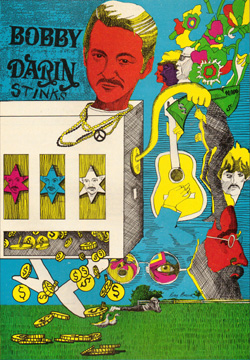
It’s the geriatrics ward of show business, a town where they made the cast of Hair put clothes on. Ah, Sodom, were you ever so plastic? When Bobby Darin comes striding onstage dressed in old blue denims, the dirtiest word they can bring themselves to call him is “Stinky.”Stinky? Some daredevil scribbled it across Bobby’s name on one of his posters in an elevator at the Sahara, and when Bobby’s eight-year-old son saw it, he came rushing back to his father’s hotel suite, his face full of hurt. Is there a more revealing commentary on Las Vegas then the fact that it considers Bobby Darin’s appearance here its first major confrontation with the Underground? When Bobby’s son tried to tell his father what he had seen, he refused to utter the word in public. Stinky? He had to whisper it into his father’s ear.
Credit the Sahara with being so bold as to risk putting Bobby on the stage of its Congo Room, singing songs of freedom, protest ballads and vignettes of his own personal musings, at $40,000 a week, no less. “I was writing songs like this 10 years ago,“ said Bobby, “but they wouldn’t let me sing them. I’d say, ‘Listen to this,’ and they’d say, ‘Yeah, that’s great, now let’s have something,’ and he snapped his fingers, “’with this in it.”
Onstage at the Sahara, he’d talk of Slicky Dick and Zero Agnew, joke about the Santa Barbara oil scandal and tell how one of his records was banned from American radio because he used the words “pot” and “hash” in it. Las Vegas is a town in which the bus stops are decorated with signs warning that you get 20 years for smoking marijuana and life for selling it, and people kept walking out in the middle of his show.
Trouble has always been no trouble at all for Bobby, a kid from the Bronx slums who grew up never knowing his father, a Mafia torpedo with addresses in New York and Chicago. Bobby arrived at his stardom with a giant splash in the late fifties, announcing to the world that he was going to be a living legend by the time he was 25. Brash? Once he sat in the Copa Lounge and coolly told the big boss his father used to work for what to do with himself.
Those were the days of “Mack the Knife,” one of the largest hits of the record business’ adolescence, and Bobby quickly installed himself as a “shtarker” on the night club circuit, one of the heavies who could pull the $80 spenders in. Even in blue denims, giving two concerts at night instead of the usual floorshow, Bobby proved a good bet for the house during his 12 nights at the Sahara.
“The only big name I know of who came in while I was here was Phil Spector,” Bobby said, “but as far as I know, he never got past the gambling tables.”
“That’s all right, Bobby, a friend replied, “the only reason Phil came in to gamble here was because your name was on the marquee.”
As a matter of fact, the Hollywood glamour crowd pointedly ignored Bobby’s appearance at the Sahara. On opening night, he accused one of Las Vegas’ most powerful columnists of reviewing his blue denims instead of his show. When the columnist then answered with another attack, Bobby took out ads in the Las Vegas newspapers. But for all the catcalls, the boos, the hecklers, the half-empty houses and the usual pre-Christmas lull in gambling, the Sahara’s casino reported one of the briskest handles on the Strip during Bobby’s 12 days there. In a town that has no other reason for existence, you can’t call him Stinky for that.
“It was 14 months since I last played this town,” Bobby announced from the stage of his closing night. “it took a lot of guts on the Hotel Sahara’s part to try me out doing what I’m doing now … they pay me a lot of money. They pay me a lot of money for something I would do and virtually have done for nothing.”
Bobby lives in a house trailer in Big Sur now. He has sold his mansion in Beverly Hills, and he has sold his beach house in Malibu and he drives a Toyota. He wears denims in honor of Martin Luther King. On the day they buried Bobby Kennedy he stood at the gravesite. He stood until after nightfall when everyone had left except the gravediggers shoveling dirt over the coffin.
He calls it a metaphysical experience now, and he refuses to talk about it anymore. But what happened was that he felt all his hostilities leave his body as if rolled up into a ball and he watched them float away up and up into the heavens. “I felt,” he said, “that if a man like that could be killed so senselessly, what was my life worth and what should I do about it?”
In his new show, Bobby doesn’t sing with a house band anymore. Instead, he has recruited four young Nashville musicians who migrated to Las Vegas as a group and who are now Bobby’s partners in a combination that may turn out to be powerful enough to play the Underground circuit as well as for $40,000 a week. Just the drummer alone, Tommy Amato, playing big band style with a Nashville twang, would have been worth the temptation involved in trying to walk past the crap tables.
Bobby doesn’t sing “Mack the Knife” anymore, either. He sings of bodies found on an Arkansas prison farm, in a song that Jackie Gleason once banned from his TV show. He sings of growing up in the slums. He sings of what it was like to have been a rock and roll singer just out for the cash at a cost of leaving his natural self behind. “How do you kill a mountain?” he asks. “How do you kill an idea?” He sings “If I Were a Carpenter” and he sings “Simple Song of Freedom.” “I just want to be ... someone known to you as me.”
As he told the audience on his closing night: There’s nothing wrong with plastic presentations until you get tired of them. But when you get tired of them, as I did, you got to put them aside and do something else.”
Home | News | Bobby | Career | Fun | Fans | Specials
bobbydarin.net, All Rights Reserved.